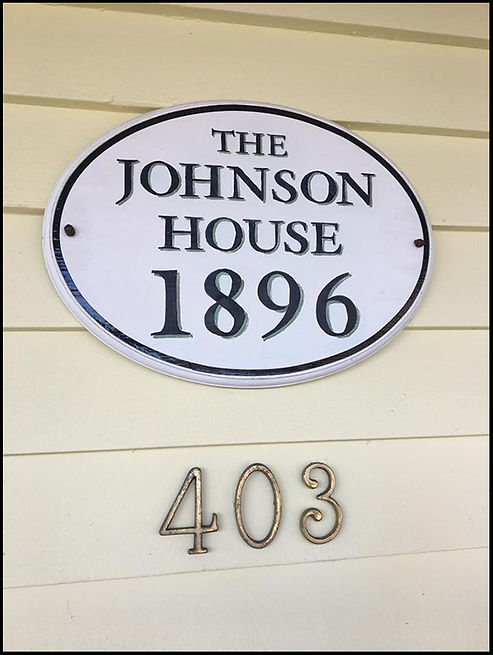
James Clark Johnson Victorian Mansion (1896 - Present)
Welcome back, Monroe history lovers. This week’s history takes us to 403 Elm Street. There, near the summit of the long ascent from Monroe Turnpike, we find the Victorian mansion of James Clark Johnson. Our first supporting image shows the mansion from a simpler time, when it was the home of the Soundview Dairy Farm, so named for the property’s unobstructed view of Long Island Sound to the south. Surely, you’ve admired it while driving on Elm Street. It is unquestionably the finest surviving example of Victorian-era architecture in Monroe. Today, we’re going to learn how it came to be, and how it continues to grace our landscape under the thoughtful custodianship of its current owners, David and Sue DeGeorge. Let’s head back in time to 1896 and learn some new history.
The current mansion is not the first home to stand on the property. Evidence of James C. Johnson’s original home is first seen on the 1867 Beers Atlas Map of Monroe. James built the home at the time of his marriage to Marietta C. Beardsley, both of whom are seen in our second and third supporting images. From his earliest days as a young man, James Johnson proved an industrious sort and earned his living from various successful ventures such as, general farming, manufacturing stirrups, a meat business, a milk business, cutting ties for the railroad, and raising strawberries for market. In our fourth supporting image, we learn that by 1891, James had advanced to become a successful General Agent for the Building and Loan Association of Dakota. Life was comfortable for the Johnson family, but all of that was soon to change.
On April 20th, 1896, Stiles M. Clark of Monroe Center drove furiously up to Marshall Beach’s store exclaiming in great excitement that James Johnson’s house was in flames! Several men jumped into Clark’s carriage, and they raced westward across the center green, down Church Street, over the Beardsley Brook and up the long hill toward the Johnson home. Upon arrival, the upper floor was fully engulfed in fire. Only some furniture and the family’s fine silver was saved. James’ son Merwin’s hands were badly burned in his failed attempt to fight the flames. The Johnson’s home, considered one of the finest in our town, soon collapsed in a burning heap. The cause of the fire was said to have been the spontaneous combustion of wallpaper, oil paint, and mineral spirits which were stored in the upper room of a new addition that had just been completed for Merwin and his wife Martha to occupy. Thankfully, the home was insured.
The family was rightfully shaken by the loss of their home and the community immediately offered comfort to their neighbor in their time of dire need. On May 1st, 1896, the Newtown Bee announced, “James Johnson will rebuild on the old site, a handsome new residence.” Like Andrew Barnum Curtiss of Stepney Depot, James contracted with the Marsh Brothers construction firm of Bridgeport to design and build his family’s grand Victorian mansion. Edward Marsh superintended the project and summoned artisans to Monroe who were housed locally in the homes of Gustavus Abbott of Elm Crossing and Solon B. Wales of Elm Street. Carpenters, plumbers, masons, lathers and plasterers went immediately to work. Many of the necessary supplies arrived by train, and carts were dispatched to Stepney Depot daily to convey critical materials to the building site. The total construction time was just over 6 months and the Johnsons occupied their new home on November 1st, 1896. Each night, the Johnson mansion could be seen for miles, its every window set aglow by modern gas lighting, a rare and magical sight in the days before electricity.
During the construction of the home, James C. Johnson was violently thrown to the ground by a lurching wagon, leaving him badly injured about the hips. He walked only with the aid of crutches, suffered from debilitating pain and was unable to lie down, resting only in his easy chair. Dr. Sweet of Milford regularly visited the patient who was making only slow progress. On December 3rd, 1896, after the doctor’s visit, James complained of faintness and made his way to the sitting room where his wife Marietta brought him his medication. Shortly thereafter, his head fell backward, he gasped and it was over. Just 3 weeks after moving into their fine new home, James Clark Johnson, one of Monroe’s most well-respected and successful men, had passed. He was just shy of his 63rd birthday. The home stayed within the Johnson family and they continued in their successful dairy business and other ventures. In the 1960s, much of the surrounding farmland was developed into the area neighborhoods we know today, and by the 1980s, the once grand home had sadly fallen into a state of disrepair. Thankfully, it was eventually restored to its former glory.
Current owners David and Sue DeGeorge purchased the Johnson mansion in 2003 and feel blessed to have raised their three children in the home. Obviously, at nearly 130 years old, their home requires maintenance and upgrading from time to time. David and Sue have made every effort to honor and complement its original architecture and the traditions of the Victorian era. Each Christmas season, the DeGeorges host a festive gathering for friends and neighbors alike. It feels as though you’re stepping back in time as you enter their fine home. Every detail is perfect, from the Victorian sleigh on the front lawn to the massive Christmas tree and yuletide carols accompanied by piano. With even the slightest imagination, you can feel the spirits of the original inhabitants present, inspiring one to take a moment to ceremoniously raise a glass of Christmas cheer to the Johnsons from a time long past.
I hope you enjoyed this week’s historical spotlight on James Clark Johnson and his family’s 1896 Victorian mansion. Their history is bittersweet but worthy of telling. Please share this post with your family and friends, or anyone with an appreciation for architecture of the Victorian period, and thank you for your continued support and interest in Monroe’s rich history. Until next time, this is my last historical spotlight for 2025. It’s been a great year for Monroe history, hasn’t it? I wish you all a very Merry Christmas, Happy Holidays, and a healthy, happy and prosperous New Year! I look forward to continuing our historical journey together once again in 2026.
Regards,
Kevin Daly
Historian, Monroe Historical Society
www.monroecthistory.org
Our Past is Always Present